What fashion forgets when culture becomes a trend.
I was recently looking for a dress to wear to a wedding: opening far too many tabs, saving dresses I probably won't buy, and convincing myself that perhaps this occasion warrants something new. Somewhere along the way, I came across Yellow the Label's Nina Silk Dress. It was beautiful: a floor-length silk gown with a high neckline, delicate floral embroidery, a dramatic draped back, and a long, coordinating scarf. It had the sort of effortless elegance, and I found myself returning to it as I continued browsing. It reminded me of something I had been noticing across contemporary fashion in the last few months. Sheer scarves draped across the shoulders of wedding guests, high-collared jackets with intricate knotted buttons, and the embroidered blouses and coordinated skirts appearing in collections from luxury fashion houses to high-street retailers.
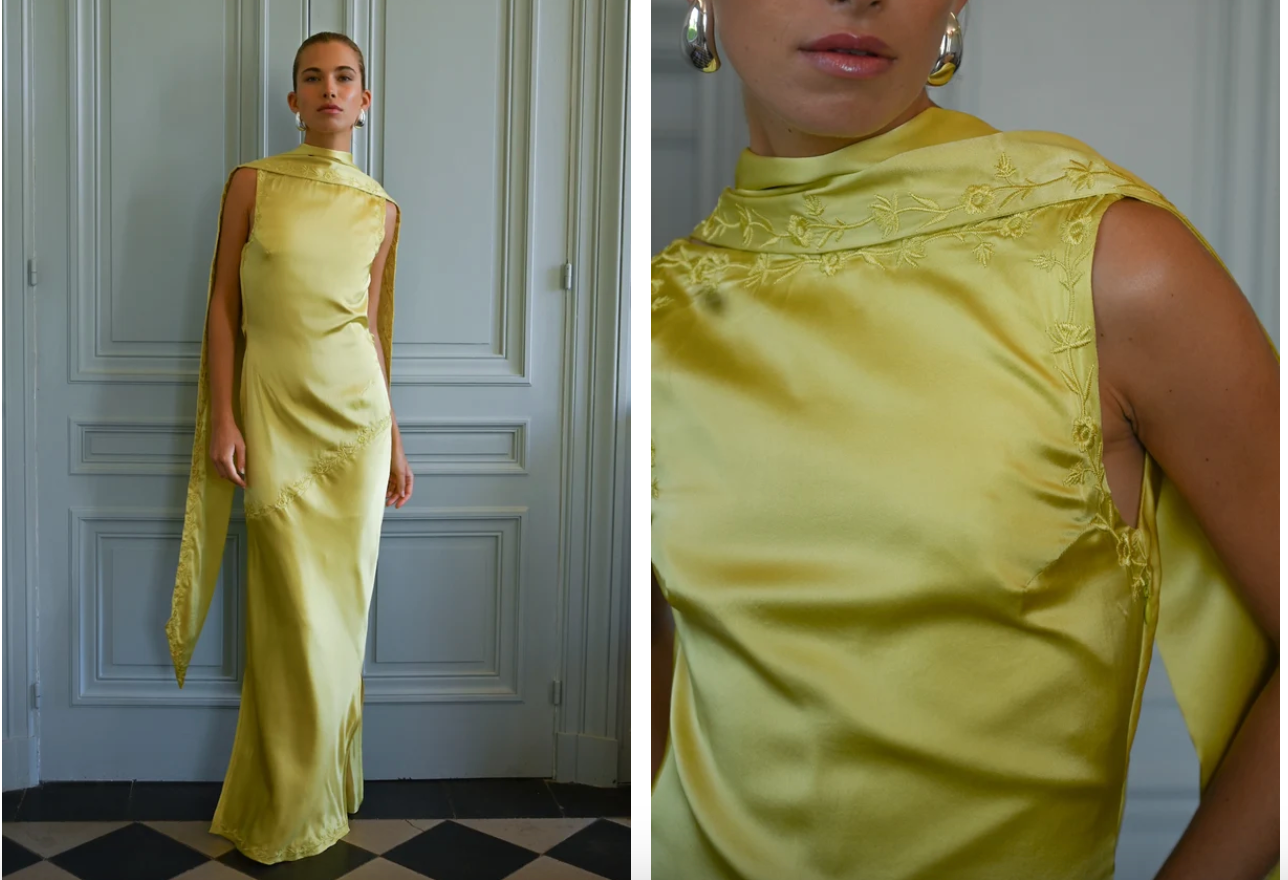
Image from Yellow the Label, Nina Silk Dress
Elements of traditional Asian and South Asian dress are appearing everywhere, often presented as the newest expressions of contemporary style. Garments and design traditions that had existed for generations were suddenly finding new audiences, new names, and, in many cases, considerably higher price tags. It made me wonder: what exactly is happening in fashion? And perhaps, more importantly, why does it so often take a Western designer or fashion house to make something that has existed for centuries appear new?
The “reinvention” of tradition
Consider the recent popularity of the so-called Scandinavian scarf. The accessory, characterized by a long, often sheer scarf draped across the shoulders or loosely around the neck, became a popular styling choice across social media, particularly for summer occasions and wedding guest attire. For many South Asian women, however, the styling was immediately recognizable. It closely resembled a dupatta, a garment worn across South Asia for generations, with varying cultural, religious, and stylistic significance. The association of this look with Scandinavian fashion prompted a wave of criticism and satire from South Asian creators, many of whom began posting videos of themselves wearing traditional dupattas under the same description. There is something nonsensical about the idea that a garment can become culturally unrecognizable through a change in vocabulary. A change that is so obviously geared toward Western affiliation and consumption. A dupatta, a familiar component of South Asian dress, becomes a European-inspired styling accessory. Its history is displaced by a new aesthetic identity, one that is presumably more recognizable or appealing to Western consumers.
Online conversations continued around April 2025, when Reformation released a collaboration with Devon Lee Carlson that included a three-piece ensemble consisting of a camisole, matching skirt, and long scarf. The outfit drew comparisons to a traditional South Asian lehenga. Around the same time, garments from Oh Polly and H&M attracted similar criticism for their resemblance to the sharara and shalwar kameez. Reformation explained that its design had been inspired by a 1990s John Galliano gown rather than directly by South Asian clothing. However, this explanation raises an interesting question about the way cultural influence circulates through fashion. If a contemporary designer references an earlier Western collection, and that collection itself draws from a longer history of non-Western design, how far back does the industry need to look before acknowledging the traditions that helped shape it?

Fashion has an extraordinary capacity to recycle its own archives. Yet in the process, cultural histories can become increasingly obscured, until a garment's most recognizable origin is no longer the community that developed it, but the fashion house that popularized its reinterpretation.
A similar phenomenon can be observed in the resurgence of Chinese-inspired clothing. The Tang jacket, or tangzhuang, has become increasingly visible in contemporary fashion, often marketed using generalized descriptions such as "Mandarin jacket" or "Asian-inspired top." The jacket, recognizable through its high collar and intricate frog-button closures, is a modern interpretation of traditional Chinese clothing with roots in Qing dynasty dress. Meanwhile, the qipao, also known as the cheongsam, developed into its modern form in twentieth-century Shanghai, reflecting changing ideas about femininity, national identity, and modernity. These garments carry different histories, but their distinguishing features are frequently absorbed into a generalized aesthetic of Eastern influence. And these trends are not solely found in feminine fashion. Band collars, frog closures, culturally specific patterns of embroidery and other trends are at the forefront of masculine fashion trends as well. Specifically in formal wear.
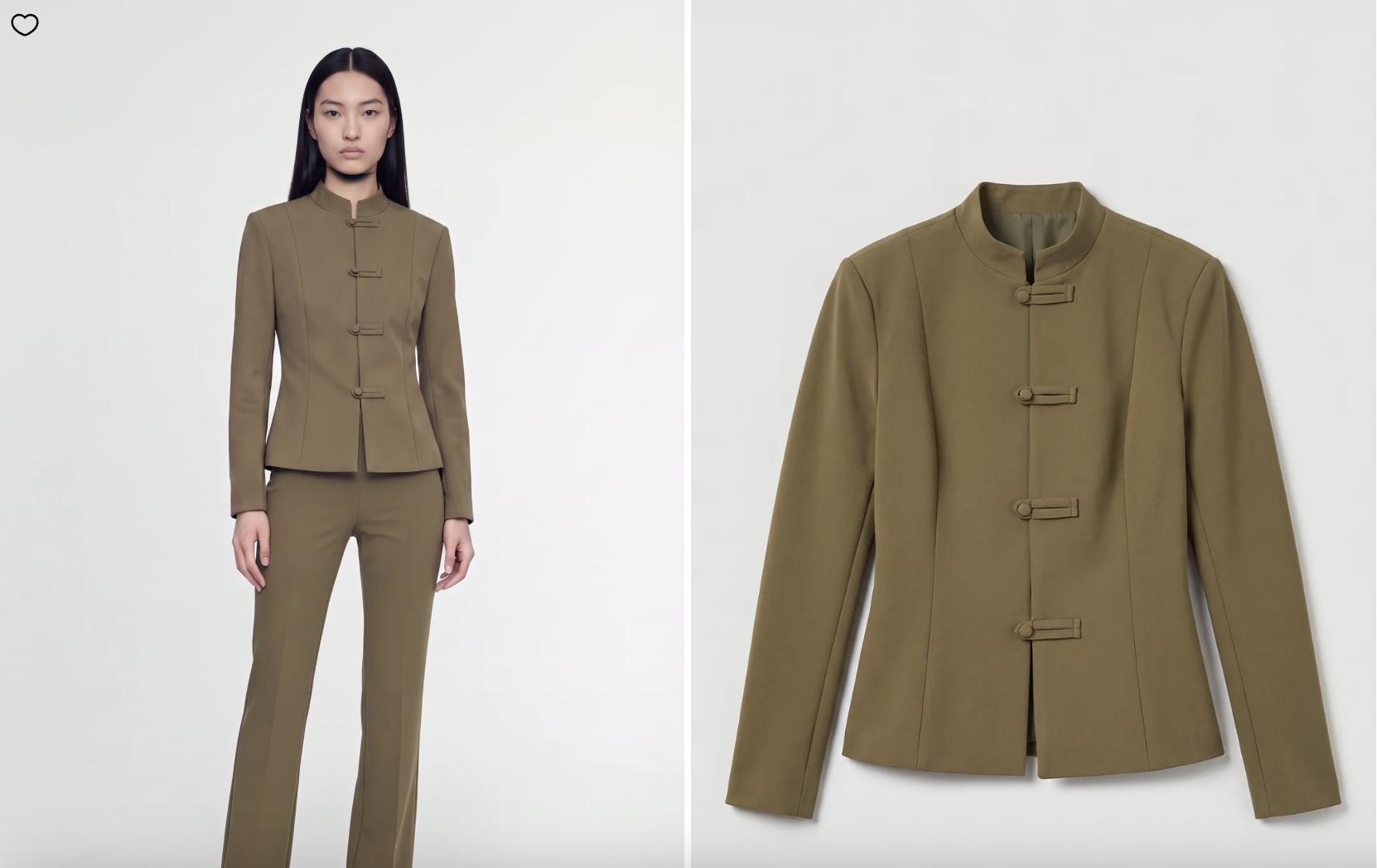
Image from maskamode.com
These labels are important because they communicate far more than the physical characteristics of clothing. They connect garments to particular places, historical developments, and cultural practices. When these references disappear, the garment remains visible while the history informing it becomes less so. What emerges is a peculiar contradiction: fashion celebrates the cultural product while progressively distancing it from its cultural origins.
Who gets to make something fashionable?
Fashion has never been separate from politics. Throughout history, clothing has communicated status, belonging, identity, and social distinction. Today, our fashion choices still have the potential to influence how others perceive us, while the institutions that govern fashion help establish what society considers beautiful, respectable, sophisticated, or desirable. Those institutions possess considerable cultural power. Designers, celebrities, editors, fashion houses, and increasingly, social media platforms, do more than respond to trends. They participate in creating them, giving certain styles visibility and legitimacy while leaving others comparatively unrecognized.
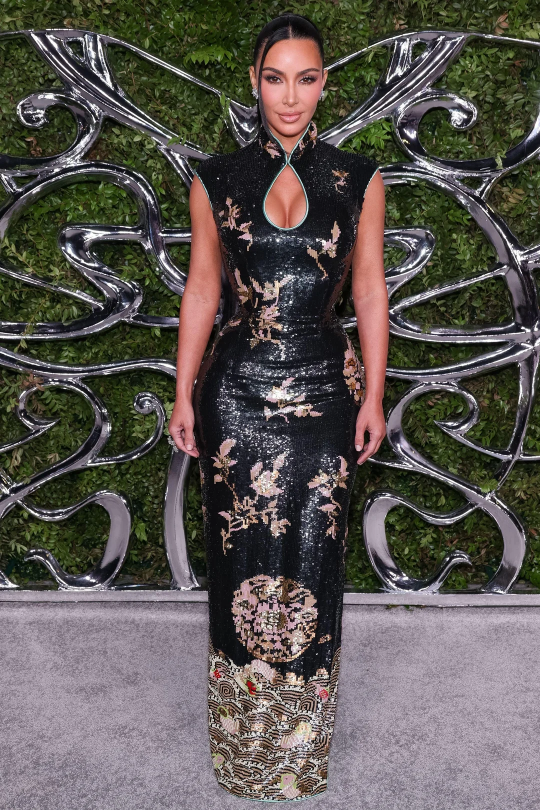
Consider Kim Kardashian's recent public appearance in September. She was styled by Law Roach in a Chinese-inspired Yves Saint Laurent gown from Tom Ford's FW04 collection. The archival look attracted attention for its elaborate detailing, distinctive silhouette, and reference to fashion history. Much of the coverage celebrated the prestige of the designer, the fashion house, and the styling. Yet the Chinese sartorial traditions informing the design received comparatively little attention. This is an interesting example of how cultural authority operates. Cultural authority is the socially constructed capacity to define truth, reality, and morality within a society. It determines which institutions, traditions, or leaders have the power to shape public beliefs and norms. And, in this case, the Western fashion house becomes the recognizable author of the garment, while the longer cultural history that informs its appearance is relegated to a descriptive influence.
The same aesthetic elements can carry remarkably different associations depending on who wears them and where they appear. For generations, members of immigrant and diasporic communities have encountered stereotypes and discrimination tied to traditional, cultural dress. Clothing that signifies tradition, identity, or belonging can also become a visible marker of difference within Western societies. Yet similar styles acquire an entirely different social meaning when presented through luxury fashion, celebrity culture, or contemporary retail. What was once regarded as foreign or old-fashioned becomes elegant, interesting, and fashion-forward.
British-Chinese writer Jenny Lau has written about her complicated relationship with the cheongsam, shaped partly by Western representations of the garment. Similarly, fashion writer Emily Chan has explored the discomfort surrounding the Tang jacket's renewed popularity, particularly against the backdrop of anti-Asian prejudice. Their observations point toward a broader contradiction in contemporary culture: we can celebrate the products of another culture while remaining far less accepting of the people at the centre of them. This tension is hardly new. Western designers have incorporated Asian aesthetics into their collections for well over a century. Paul Poiret, Yves Saint Laurent, John Galliano, and numerous others have contributed to a long history of reinterpretation, one in which the distinction between artistic exchange and exoticization has frequently been contested.
The Metropolitan Museum of Art's 2015 exhibition, China: Through the Looking Glass, brought this relationship into particularly sharp focus. The exhibition explored Chinese influence on Western fashion, while also prompting debate about Orientalism and the tendency to interpret Chinese culture through Western artistic fantasies. Edward Said's concept of Orientalism is important here. Said examined how Western representations of Eastern societies were shaped by unequal relationships of knowledge and power, frequently reducing diverse peoples and cultures to simplified, exoticized ideas. These representations were not merely artistic interpretations. They helped establish who possessed the authority to describe, define, and assign meaning to other cultures. Fashion reproduces aspects of this dynamic when cultural traditions become raw material for Western creativity, particularly when the original makers and communities are absent from the story being told. And the consequences extend beyond representation. They are economic, social and political.
Colonialism, capitalism, and the business of borrowing
In June 2025, Prada debuted a pair of open-toe leather sandals that closely resembled the traditional Kolhapuri chappal, handcrafted footwear originating in the Indian states of Maharashtra and Karnataka. The resemblance was quickly recognized, and controversy followed when the design's Indian heritage was not initially acknowledged. What made the incident especially revealing was the contrast between the traditional footwear and its luxury reinterpretation. Indian artisans had spent generations producing variations of these sandals, preserving techniques and sustaining local craft traditions. Yet a similar design, presented through the prestige of a European fashion house, entered a radically different commercial and cultural market. The craftsmanship and design history were already there. What changed was the institution presenting them to consumers. Following criticism, Prada acknowledged the inspiration. In April 2026, the company went further, introducing a limited-edition collection made in India in collaboration with organizations supporting the traditional Kolhapuri footwear industry, alongside an artisan training initiative. The development demonstrates how public scrutiny can push fashion houses toward more meaningful forms of recognition and collaboration.
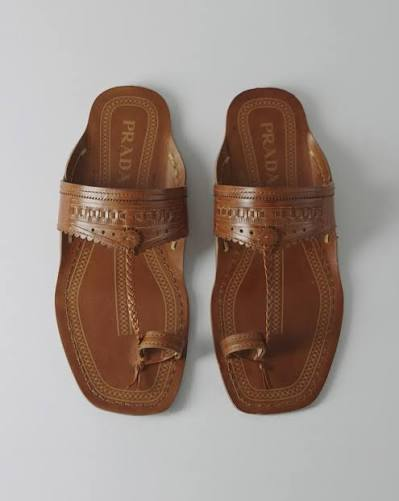
The Prada controversy illustrates something larger about the global fashion economy. We often understand colonialism as a historical period, defined by territorial conquest, political domination, and the extraction of resources. Yet the end of formal colonial rule did not dissolve the economic and cultural inequalities established through centuries of imperial expansion. Those relationships have evolved, taking on different forms within contemporary institutions and markets.
Historically, colonial economies often depended on extracting materials and labour from colonized territories, while more substantial profits accumulated elsewhere through imperial trade and commercial networks. In contemporary fashion, a related imbalance can emerge when traditional cultural practices provide the creative foundation for products whose greatest commercial rewards are captured by global brands. The resources being drawn upon are not exclusively cotton, silk, or natural dyes. They are also techniques, patterns, silhouettes, and generations of accumulated cultural knowledge. The process becomes especially visible when a traditional design is reframed as a contemporary innovation, sold at a considerable markup, and celebrated for its originality.
What makes this dynamic particularly striking is fashion's dependence on novelty. Something must always be new and trendy, even when it has existed somewhere else for centuries. A traditional garment becomes an aesthetic. An aesthetic becomes a microtrend. A microtrend becomes a marketable product. And, eventually, the industry moves on. Social media has only accelerated this process. Where trends once circulated through fashion magazines, runway collections, and seasonal retail cycles, contemporary platforms can transform an aesthetic into a global phenomenon almost overnight. Luxury fashion houses may establish the prestige of a particular silhouette, but high-street and fast-fashion retailers rapidly reproduce variations for much larger consumer audiences. As designs move through these commercial networks, the histories associated with them can become increasingly diluted. The garment might remain recognizable, but the people, places, and practices that gave it meaning are no longer part of how it is marketed. This is where questions of cultural appropriation become inseparable from questions of capitalism: who creates cultural value, who determines its worth, and who ultimately benefits from its commercialization?
Beyond appreciation and appropriation
The tension between cultural exchange and appropriation is often reduced to a question of whether someone should wear clothing associated with a culture other than their own. Fashion's history is, in many respects, a history of cultural exchange. Silks, dyes, embroidery techniques, tailoring traditions, and decorative motifs have moved across borders for centuries, evolving through trade, migration, and artistic encounters. The qipao itself reflects this history, having developed through a combination of Chinese sartorial traditions and changing global influences. These exchanges are part of what makes fashion culturally significant. What deserves closer attention is the unequal distribution of influence, recognition, and economic opportunity within those exchanges.
In 2022, Mexico introduced federal legislation protecting the collective cultural heritage and intellectual property of Indigenous and Afro-Mexican communities. The law recognizes communities' authority over elements of their cultural heritage and establishes protections against unauthorized commercial exploitation. The legislation reflects growing recognition that traditional cultural knowledge carries value extending beyond its potential use as commercial inspiration. Within the fashion industry, this could mean reconsidering how brands acknowledge cultural references, involve traditional artisans in production, and distribute the financial benefits arising from their work. There are already examples of designers collaborating directly with communities to preserve craft traditions while introducing them to wider markets. Such partnerships offer possibilities for cultural exchange in which recognition and economic opportunity are shared rather than concentrated. However, these practices also raise larger questions about the responsibilities of an industry that profits so extensively from cultural production.
Fashion houses possess the financial resources, global reach, and institutional influence to shape how cultural traditions are represented to consumers. Their decisions affect not only what becomes fashionable, but also whose creativity becomes visible and economically valuable. And consumers participate in this process, often without knowing the historical relationships behind the garments they purchase.
I return, then, to the dress that started this train of thought:
An embroidered silk gown, a coordinating scarf, and a few too many open shopping tabs led me toward a much larger question about the relationship between culture and power. Fashion has always moved between cultures. But when cultural traditions are transformed into contemporary trends, the history of that movement matters. We live in a world where cultural exchange happens more rapidly and visibly than ever before. Yet greater exposure to cultural products does not necessarily produce greater understanding of the societies from which they emerge. A garment can become internationally desirable without its history becoming widely known. An aesthetic can become fashionable without the people associated with it receiving recognition. And a cultural tradition can generate enormous commercial value without that value finding its way back to the communities that sustained it.
So, perhaps, the next time we encounter a seemingly new trend, we should pause to consider these questions: Who made this familiar before it became fashionable? Why do certain cultural traditions gain recognition only after being reinterpreted by powerful designers, celebrities, or fashion houses? When we purchase clothing inspired by another culture, whose creativity are we supporting, and whose history are we being told? And perhaps most importantly, when the trend inevitably passes, what remains?
— J
References
Allaire, C. (2023, August 18). Is fashion finally turning the page on cultural appropriation? Vogue.
https://www.vogue.com/article/cultural-appropriation-appreciation-fashion-september-2023
Chan, E. (2026, February 17). The Tang jacket is trending right now – here's why that makes me feel uncomfortable. British Vogue.
https://www.vogue.co.uk/article/tang-jacket-trend-viewpoint
Gupta, G. (2025, April 15). TikTokers accuse fashion brands of appropriating South Asian culture. The Washington Post.
https://www.washingtonpost.com/technology/2025/04/15/reformation-carlson-lehenga-tiktok/
Lau, J. (2026, February 19). As a British-Chinese person, I avoided wearing a cheongsam for 38 years – now I can't live without them. British Vogue.
https://www.vogue.co.uk/article/cheongsam-viewpoint
Metropolitan Museum of Art. (2015). China: Through the Looking Glass. Exhibition materials.
https://www.metmuseum.org/exhibitions/listings/2015/china-through-the-looking-glass
Michie, N. (2026, September 21). Kim Kardashian's Law Roach-era starts with Y2K YSL. W Magazine.
https://www.wmagazine.com/fashion/kim-kardashian-law-roach-yves-saint-laurent
Pham, M.-H. T. (2019). China: Through the Looking Glass: Race, property, and the possessive investment in white feelings. In Fashion and Beauty in the Time of Asia. NYU Press.
https://academic.oup.com/nyu-press-scholarship-online/book/31214/chapter-abstract/309285755
Prada Group. (2026, April 27). Prada Made in India x Inspired by Kolhapuri Chappals.
https://www.pradagroup.com/en/news-media/news-section/26-04-27-prada-kolhapuri.html
Reuters. (2025, June 28). Sandal scandal: Prada credits new design's Indian legacy amid furore.
https://www.reuters.com/world/india/sandal-scandal-prada-credits-new-designs-indian-legacy-amid-furore-2025-06-28/
United Mexican States, Chamber of Deputies. (2022). Ley Federal de Protección del Patrimonio Cultural de los Pueblos y Comunidades Indígenas y Afromexicanas.
https://www.diputados.gob.mx/LeyesBiblio/pdf/LFPPCPCIA.pdf
Yellow the Label. (n.d.). Nina Silk Dress. Product descriptions.
https://yllwthelabel.com/products/nina-silk-dress-azalea
https://yllwthelabel.com/products/nina-silk-dress-chartreuse
Bose, M. B. (2024). Ties that bind: Fashion, textiles, and gendered labour in South Asia today. South Asian History and Culture, 15(1), 1–10.
https://doi.org/10.1080/19472498.2024.2311034
Said, E. W. (1978). Orientalism. Pantheon Books.
